

August 16, 2020
The Schist Villages of the Serra do Açor
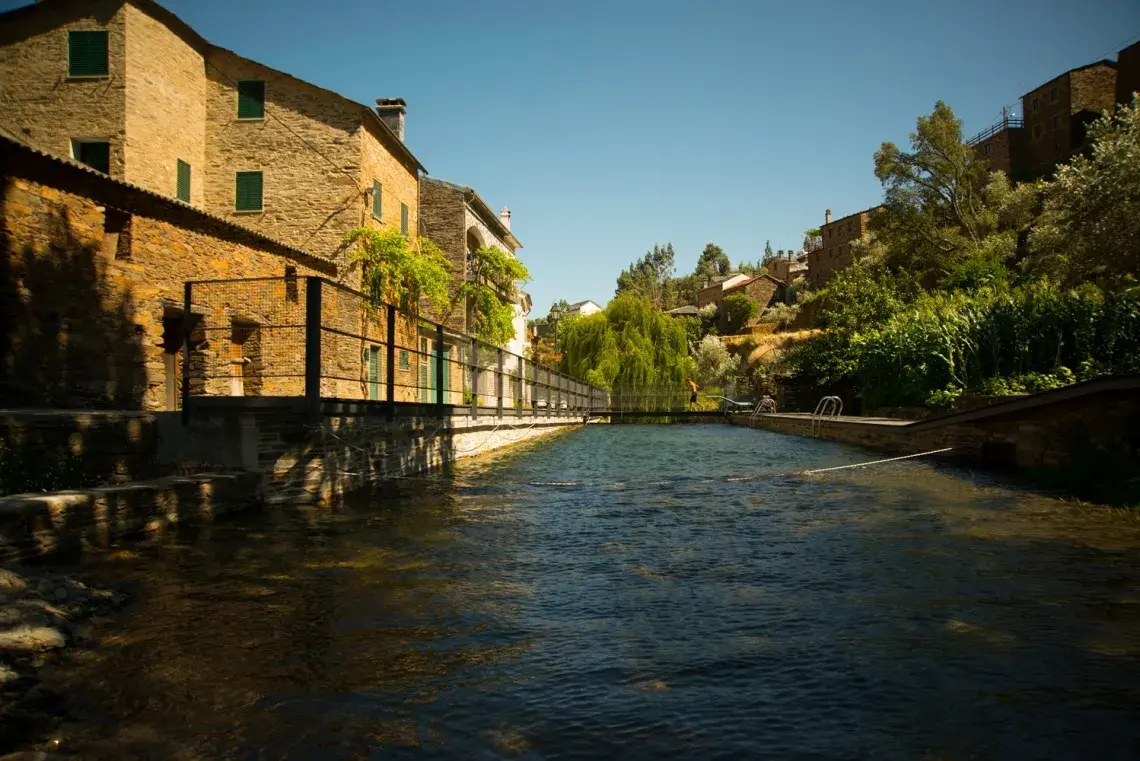
In "our" mountain range alone — the Serra do Açor, the highest schist mountain formation in the country — five villages belong to Portugal's Schist Villages network (Aldeias do Xisto). Here they are:
Benfeita
Known as the "white village" or the "village of peace". To this day, Benfeita marks the end of the Second World War every 7 May with 1,620 chimes of its bell — one for each day the war lasted. It is said to be the only village in the world to commemorate the date with a tower, a bell and a clock.
The village is very close to Fraga da Pena and the Mata da Margaraça, two of the true icons of the Serra do Açor. A 12 km trail loops around it — highly recommended for nature lovers.
Aldeia das Dez
Known as the "village of flowers", Aldeia das Dez has enormous natural charm. The whole village feels like a viewpoint over the mountains, and it boasts a unique historic heritage, including the ruins of a Luso-Roman hillfort.
If you have a sweet tooth, try a delicious strawberry-tree liqueur (medronho) with the coscoréis and cavacas made the Aldeia das Dez way.
Fajão
Fajão lives alongside the giant quartzite rocks of the Penedos de Fajão, whose shapes resemble natural castles. The village is bathed by the clear waters of the River Ceira, which rises in the Serra do Açor.
(…) whoever climbs to the Rocha, at the top of the mountain, 1,186 m high, may then gaze east, south and west over a dazzling panorama of wide horizons stretching from the depths of Beira Baixa and Estremadura, a sea of brown, yellow, blue and violet mountains whose undulation recalls a great cavalcade rising to charge at the Estrela (Guilherme Filipe, 1944).
The village has its own museum, with woodcuts, watercolours of Fajão and other historic relics, such as its first public telephone.
Vila Cova de Alva
This is the schist village with the richest heritage, notably a convent built by the Franciscan (Capuchin) order. It also enjoys a lovely view over the River Alva.
Wander through its streets and alleys — the 16th-century Rua Quinhentista stands out — and take a break in its pleasant squares, such as the Largo da Igreja Matriz and the Pelourinho, where you can see two 17th-century manor houses: the Solar dos Condes da Guarda and the Solar Abreu Mesquita.
Sobral de São Miguel
The village dates back to Roman times, when it lay on one of the most important trade routes — "the salt route". Its inhabitants call it "the heart of schist", as it has one of the largest clusters of schist buildings in Portugal.
It later grew thanks to the Panasqueira mines and their tungsten (wolfram) extraction, considered one of the finest in the world.
To explore the five schist villages of the Serra do Açor at your own pace, Villa Montês guests have self-guided itineraries in the digital house guide we send them. For anything else, get in touch.